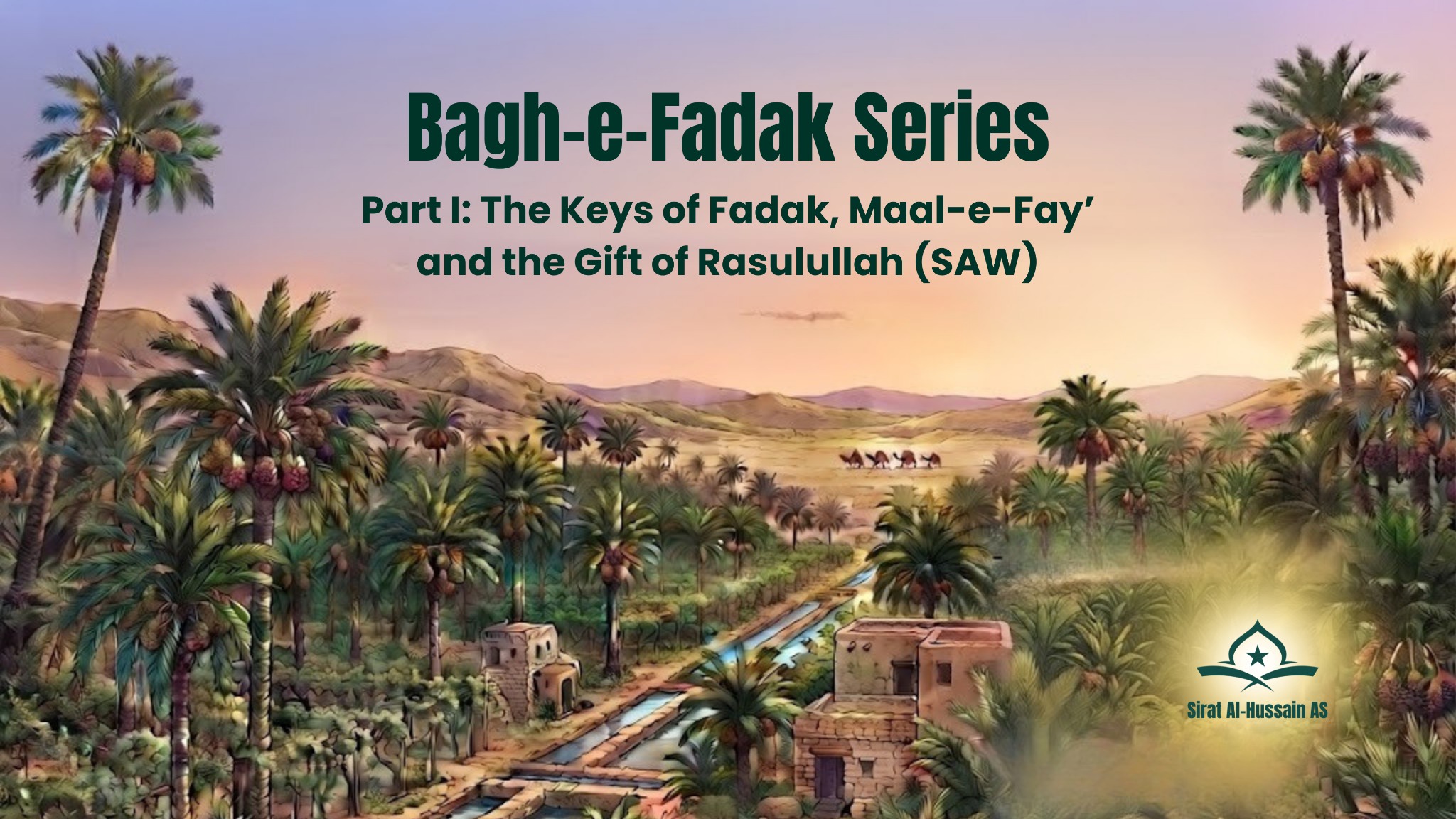
The miraculous acquisition of Fadak, the Quranic laws governing Maal-e-Fay’, and the written deed granting Fadak to Sayyida Fatima al-Zahra (SA).
Introduction: The Land Granted by Allah
In the seventh year after the Hijrah, a fortified agricultural settlement near Khaybar became the setting of events that would shape one of the most consequential property disputes in early Islamic history.
After the Muslim victory at Khaybar, the inhabitants of Fadak knew their settlement might be next. They secured the fortifications, locked the gates and concealed the keys. Ibn Shahr Ashub, in Manaqib Aal Abi Talib, records that when they confronted Prophet Muhammad (SAW), the keys they believed safely hidden were already in his possession. Astonished, they asked who had delivered them. Rasulullah (SAW) named Hazrat Jibreel (AS), the angel who had brought the Tablets to Prophet Musa (AS).
Qutb al-Din al-Rawandi preserves another account in Al-Khara'ij wa al-Jara'ih, transmitted from Imam Ja'far al-Sadiq (AS). In that report, Jibreel (AS) brings the Prophet to Fadak, opens its gates and shows him the settlement. The accounts differ in some details; both connect the keys of Fadak with Jibreel (AS), and both place the episode within the Prophet's authority over property acquired without a conventional battle.
Fadak's legal status is central. Its surrendered portion was Maal-e-Fay’ (مالِ فَے), not ordinary Maal-e-Ghanimah (مالِ غنیمت). The distinction explains why it did not become a pool of battlefield spoils for the soldiers who had fought at Khaybar. The people of Fadak came to terms with Rasulullah (SAW); the Muslim army did not fight a battle to take Fadak itself.
Allah's command concerning the near relative's due is also central to the account of the gift. Muhammad ibn Mas'ud al-Ayyashi in Tafsir al-Ayyashi, Ibn Shahr Ashub in Manaqib Aal Abi Talib, and Shaykh Ja'far Subhani in The Message connect the verse with the Prophet's grant of Fadak to his daughter, Sayyida Fatima al-Zahra (SA). Al-Rawandi further records that Rasulullah (SAW) instructed Imam Ali ibn Abi Talib (AS) to prepare a written deed of the gift.
Before Fadak became the subject of a dispute after the Prophet's passing, its story therefore already brought together three issues: the accounts of its extraordinary opening, its classification as Fay’, and the grant made to Sayyida Fatima (SA) during Rasulullah's lifetime. This is where the history of Bagh-e-Fadak begins.
1. What Was Bagh-e-Fadak?
Fadak (فدك) was a fertile agricultural settlement in the Hijaz, situated near Khaybar and north of Madinah. Although commonly called Bagh-e-Fadak—the Garden of Fadak—it was more than one garden. It included cultivated plots, extensive date-palm groves, water resources and fortified properties. Its residents depended on agriculture and the settlement's produce.
Shaykh Ja'far Subhani, in The Message, Chapter 44, describes Fadak as a developed and fertile settlement about 140 kilometres from Madinah. Classical geographers described it as roughly two or three days' journey from the city. The old oasis is commonly associated with the area around present-day al-Ha'it in Saudi Arabia. Historical descriptions do not always use identical boundaries or measures, so modern identifications should be treated as approximate.
The agricultural wealth of Fadak
In seventh-century Arabia, productive land with reliable water was a major source of wealth. Much of the peninsula was arid. An oasis could sustain permanent settlement, date cultivation and other agricultural activity, while also supplying travellers and nearby communities.
Date palms produced food that could be eaten fresh, dried, stored, transported and traded. Cultivated land could provide recurring income through each harvest, unlike a single sum that might be spent. It could support households, pay workers, meet charitable obligations and create a stable source of revenue.
The precise annual income of Fadak is difficult to establish. Later histories give differing figures, and those figures should not automatically be treated as contemporary accounts from the Prophet's lifetime. The important point for the events that follow is that Fadak was a productive estate with continuing value, not simply a symbolic parcel of land.
Its value lay in both the land and the livelihood its produce could provide year after year.
2. The Victory of Khaybar and the Fear of Fadak's Inhabitants
The events leading to Fadak's acquisition took place after the Muslim campaign at Khaybar in 7 AH, approximately 628 CE. Khaybar was a fortified settlement north of Madinah. Its forts and agricultural resources made it an important regional centre. Rasulullah (SAW) led the Muslim forces in the campaign.
Imam Ali (AS) and Khaybar
The victory at Khaybar occupies a distinguished place in the history of the Ahlulbayt (AS). Hadith works preserve the Prophet's declaration that he would give the banner to a man who loved Allah and His Messenger and was loved by Allah and His Messenger. Rasulullah (SAW) entrusted the banner to Amir al-Mu'minin Imam Ali ibn Abi Talib (AS). Imam Ali's courage and decisive role in the campaign became among the most celebrated episodes of his life.
The fall of Khaybar's fortifications changed the political circumstances of surrounding settlements. Fadak was near enough for its inhabitants to understand that the outcome could affect them. They faced a choice: prepare for a confrontation or negotiate. Shaykh Ja'far Subhani recounts that Fadak's inhabitants chose an agreement rather than fighting a direct battle against the Muslims.
The distinction between Khaybar and Fadak matters. The Muslim forces fought at Khaybar; Fadak itself came under Rasulullah's authority through an agreement. The accounts of the hidden keys describe the extraordinary circumstances of the Prophet's arrival, while the legal classification of the land rests on the absence of a military campaign fought to capture Fadak.
3. The Hidden Keys of Fadak: Ibn Shahr Ashub's Account
Ibn Shahr Ashub records an account of Fadak's keys in Manaqib Aal Abi Talib, Volume 1, page 123. Rasulullah (SAW) confronted the inhabitants concerning their fortified settlement. They believed their gates could not be opened because the keys were securely hidden.
The custodian, whom Ibn Shahr Ashub calls the dayyan, had been entrusted with the keys. He concealed them inside a container, placed that container in a chest and secured the chest in a locked building. The inhabitants suspected that the custodian had accepted Islam secretly and handed the keys to Rasulullah (SAW). He denied this and insisted that he had left them in their hiding place.
When the hiding place was checked, the keys were gone. The custodian was astonished. Ibn Shahr Ashub says that he had taken precautions and recited passages from the Torah over the keys because he feared the Prophet might obtain them through extraordinary means. Yet his safeguards had not prevented their disappearance.
Who brought the keys?
The inhabitants returned to Rasulullah (SAW) and asked who had delivered the keys. Ibn Shahr Ashub preserves the Prophet's answer:
أَعْطَانِيهَا الَّذِي أَعْطَى مُوسَى الْأَلْوَاحَ، جَبْرَئِيلُ
“The one who gave Musa the Tablets gave them to me—Jibreel.”
— Manaqib Aal Abi Talib, Vol. 1, p. 123
The answer names Hazrat Jibreel (AS), the angel entrusted with divine revelation. Ibn Shahr Ashub says the custodian recognised the extraordinary nature of the event and professed Islam. He also records that the gates were opened, some inhabitants accepted Islam, and the people were allowed to remain in their homes under the arrangement made with Rasulullah (SAW).
This account does not describe the ordinary military capture of Fadak. It presents the keys as a sign of the Prophet's authority and of the extraordinary means by which the settlement's gates were opened.
4. Imam Ja'far al-Sadiq (AS) Describes Jibreel (AS) Opening Fadak
Qutb al-Din al-Rawandi preserves another report in Al-Khara'ij wa al-Jara'ih, Volume 1, pages 112–113. He transmits it from Imam Ja'far al-Sadiq (AS), who describes Rasulullah (SAW) reaching Fadak through a miraculous journey.
Jibreel (AS) comes to Rasulullah (SAW)
In Imam al-Sadiq's (AS) account, the Prophet was returning from an expedition. He stopped on the road and was eating with his companions when Hazrat Jibreel (AS) appeared and instructed him to mount his riding animal. The Prophet did so. The report describes the distance being shortened in a miraculous way:
فَطُوِيَتْ لَهُ الْأَرْضُ كَطَيِّ الثَّوْبِ
“The earth was folded for him like the folding of a garment.”
Thus, Rasulullah (SAW) reached Fadak.
The inhabitants flee towards the hills
When the inhabitants heard the sound of an approaching horse, they became frightened, hurried to secure the gates and fled towards the surrounding hills. Al-Rawandi's report says they entrusted the keys to an elderly woman who lived outside the settlement. Jibreel (AS) approached her and obtained the keys. He opened the gates and accompanied Rasulullah (SAW) through Fadak.
The angel shows the Prophet the settlement
Imam al-Sadiq's (AS) account describes Jibreel (AS) leading the Prophet through the settlement and its cultivated properties. The angel informed Rasulullah (SAW) that Allah had granted the land to him. Jibreel then secured the gates and handed the keys to the Prophet, who placed them in the sheath of his sword. The distance was folded again, allowing Rasulullah (SAW) to return to his companions.
When the Prophet told his companions that he had reached Fadak and Allah had granted it to him, some reacted with disbelief. Al-Rawandi says Rasulullah (SAW) produced the keys from his sword sheath as a visible sign of his journey.
Comparing the two reports
The two reports share the central detail that the keys reached Rasulullah (SAW) through Jibreel (AS), but their circumstances differ. Ibn Shahr Ashub describes a male custodian hiding the keys inside a locked building and the Prophet producing them before the inhabitants. Al-Rawandi describes an elderly woman holding the keys outside the settlement and the Prophet showing them to his companions after the journey. These differences should remain visible when the accounts are retold; they should not be blended into one supposedly identical narration.
Both reports place the keys within a larger account of Fadak's acquisition. The legal question—whether the land was obtained by battle or by agreement—must also be considered, because it determines how the property is classified.
5. The Peace Agreement of Fadak
Shaykh Ja'far Subhani, in The Message, recounts that the inhabitants agreed to surrender a share of their agricultural produce while remaining in their homes under Muslim protection. Other historical accounts describe the terms as involving half of the land and its agricultural holdings. The wording and precise extent of the agreement vary between reports.
The core point in these accounts is that Fadak was acquired by agreement rather than through an ordinary military conquest of the settlement. Its inhabitants continued agricultural activity under the terms made with Rasulullah (SAW), and the Prophet acquired a defined entitlement in the estate.
Why the method of acquisition mattered
Islamic sources distinguish property obtained in battle from property surrendered without fighting. The soldiers who fought at Khaybar did not fight a separate battle at Fadak. The property's classification therefore could not be decided simply by noting that the Muslim army was active in the region. The relevant question was how Fadak itself came under the Prophet's authority.
The Quran addresses property that Allah grants to His Messenger without the believers having to mobilise horses and camels for battle. This is the category known as Fay’.
6. Fadak Was Maal-e-Fay’ — Not Maal-e-Ghanimah
مالِ فَے — property acquired without ordinary military fighting
This distinction forms the legal foundation of the case presented by Ibn Shahr Ashub, al-Rawandi and Shaykh Ja'far Subhani concerning Fadak. It explains why the Prophet possessed authority over the property and why it did not become ordinary battlefield spoils for distribution among the soldiers.
What is Maal-e-Ghanimah?
Maal-e-Ghanimah refers to property acquired through fighting. The Quran discusses the distribution of ghanīmah and the one-fifth share in Surah al-Anfal, verse 41. Rules concerning land are not always identical to rules concerning movable property, so the legal treatment should not be reduced to the claim that every conquered estate automatically belonged to individual soldiers.
Surah al-Anfal (8:41): the verse on ghanimah
M. H. Shakir's translation, hosted by Al-Islam.org, gives the verse as follows:
وَاعْلَمُوا أَنَّمَا غَنِمْتُم مِّن شَيْءٍ فَأَنَّ لِلَّهِ خُمُسَهُ وَلِلرَّسُولِ وَلِذِي الْقُرْبَىٰ وَالْيَتَامَىٰ وَالْمَسَاكِينِ وَابْنِ السَّبِيلِ إِن كُنتُمْ آمَنتُم بِاللَّهِ وَمَا أَنزَلْنَا عَلَىٰ عَبْدِنَا يَوْمَ الْفُرْقَانِ يَوْمَ الْتَقَى الْجَمْعَانِ ۗ وَاللَّهُ عَلَىٰ كُلِّ شَيْءٍ قَدِيرٌ
“And know that whatever thing you gain, a fifth of it is for Allah and for the Messenger, and for the near of kin and the orphans and the needy and the wayfarer, if you believe in Allah and in that which We revealed to Our servant, on the day of distinction, the day on which the two parties met; and Allah has power over all things.”
— Qur’an, Surah al-Anfal, 8:41; translation: M. H. Shakir, Al-Islam.org
This verse names the categories connected with the one-fifth share of ghanīmah. It is relevant to the comparison, but Fadak's status is not established by treating it as spoils from a battle at Fadak. The reports of the agreement and the Quranic treatment of Fay’ must be read alongside it.
What is Maal-e-Fay’?
The Arabic term Fay’ (فيء) is connected with the sense of return or restoration. In An Enlightening Commentary into the Light of the Holy Qur’an, volume 18, the commentary on Surah al-Hashr explains that afa’a and Fay’ refer to property obtained without bloodshed and expedition and placed at the disposal of the Muslim community's leader. This is a named commentary, not a general appeal to an unnamed school of law.
Sayyid Muhammad Baqir al-Sadr discusses Fay’ and Anfal in Iqtisaduna. His discussion includes land obtained without fighting, property obtained through reconciliation and other categories placed under the authority of the Prophet or Imam. Shaykh Ja'far Subhani applies that legal distinction to Fadak in The Message, Chapter 44.
Why was Fadak Maal-e-Fay’?
The inhabitants of Fadak entered an agreement with Rasulullah (SAW); the Muslim army did not conduct an ordinary conquest of the settlement. The property therefore came under the Prophet's authority as Fay’. The soldiers who fought at Khaybar did not automatically acquire individual shares in Fadak as battle spoils.
| Maal-e-Ghanimah | Maal-e-Fay’ |
|---|---|
| Property obtained through fighting | Property obtained without ordinary military fighting, including through agreement |
| The Quran identifies rules for distribution, including the one-fifth share in 8:41 | The Quran discusses its special treatment in 59:6–7 |
| Its distribution depends on the form of property and applicable rulings | Its administration is connected in the cited texts to Rasulullah (SAW), and after him the rightful Imam (AS) |
| Fadak itself was not taken through a battle at Fadak | The peace agreement and lack of battle are the basis for classifying Fadak as Fay’ |
Fadak was Maal-e-Fay’. It was not property the soldiers had earned by fighting for Fadak itself.
7. The Quranic Proof: Surah al-Hashr, Verse 6
Allah says:
وَمَا أَفَاءَ اللَّهُ عَلَىٰ رَسُولِهِ مِنْهُمْ فَمَا أَوْجَفْتُمْ عَلَيْهِ مِنْ خَيْلٍ وَلَا رِكَابٍ وَلَٰكِنَّ اللَّهَ يُسَلِّطُ رُسُلَهُ عَلَىٰ مَنْ يَشَاءُ وَاللَّهُ عَلَىٰ كُلِّ شَيْءٍ قَدِيرٌ
“And whatever Allah gave as spoils to His Messenger from them—you did not press forward against it any horse or riding camel; but Allah gives authority to His messengers over whom He pleases, and Allah has power over all things.”
— Qur’an, Surah al-Hashr, 59:6; translation: M. H. Shakir, Al-Islam.org
The immediate context of verses 59:6–7 is the property of Banu al-Nadir. The verse describes property that the believers did not seize through the ordinary mobilisation of cavalry and camelry. The commentary An Enlightening Commentary into the Light of the Holy Qur’an, volume 18, explains the word afa’a through its connection to Fay’ and describes the category as property obtained without bloodshed or expedition.
Shaykh Ja'far Subhani uses this distinction when explaining Fadak: the settlement came under Rasulullah's authority without a battle fought there. The verse is thus relevant to the legal category being applied to Fadak, while the historical reports about Fadak's own agreement establish how that settlement came under the Prophet's control.
Surah al-Hashr (59:7): the beneficiaries and purpose
The next verse continues the subject:
مَا أَفَاءَ اللَّهُ عَلَىٰ رَسُولِهِ مِنْ أَهْلِ الْقُرَىٰ فَلِلَّهِ وَلِلرَّسُولِ وَلِذِي الْقُرْبَىٰ وَالْيَتَامَىٰ وَالْمَسَاكِينِ وَابْنِ السَّبِيلِ كَيْ لَا يَكُونَ دُولَةً بَيْنَ الْأَغْنِيَاءِ مِنْكُمْ ۚ وَمَا آتَاكُمُ الرَّسُولُ فَخُذُوهُ وَمَا نَهَاكُمْ عَنْهُ فَانتَهُوا ۚ وَاتَّقُوا اللَّهَ ۖ إِنَّ اللَّهَ شَدِيدُ الْعِقَابِ
“Whatever Allah has restored to His Messenger from the people of the towns, it is for Allah and for the Messenger and for the near of kin and the orphans and the needy and the wayfarer, so that it may not be a thing taken by turns among the rich of you; and whatever the Messenger gives you, accept it, and from whatever he forbids you, keep back; and be careful of your duty to Allah; surely Allah is severe in retributing evil.”
— Qur’an, Surah al-Hashr, 59:7; translation: M. H. Shakir, Al-Islam.org
The verse names Allah, the Messenger, Dhi al-Qurba (the near relatives), orphans, the needy and travellers. It also states that wealth must not circulate only among the rich. Al-Islam.org's Shakir translation and the commentary in An Enlightening Commentary, volume 18, provide the text and explanation of these words.
The verse is part of the Quranic framework for Fay’. The specific command that al-Ayyashi and al-Tabarsi connect with the grant to Sayyida Fatima (SA) is also stated in Surah al-Isra, 17:26.
Was Fadak private property or an asset under the Prophet's authority?
The sources describe Fay’ and Anfal as property subject to the Prophet's authority and responsibility. That authority included administration and the lawful allocation of its benefits. Sayyid Muhammad Baqir al-Sadr discusses this framework in Iqtisaduna; Shaykh Ja'far Subhani discusses its application to Fadak in The Message.
The point is not to force a modern category onto seventh-century property. The question in the sources is who had authority to administer Fay’ and whether the Prophet could make a grant from the property over which Allah had given him authority. The gift account answers that question by reporting that Rasulullah (SAW) gave his entitlement in Fadak to his daughter.
8. The Rights of the Ahlulbayt (AS) in the Distribution of Wealth
Surah al-Hashr 59:7 expressly names Dhi al-Qurba among the recipients associated with Fay’. Al-Ayyashi's Tafsir and al-Tabarsi's Majma' al-Bayan discuss the Prophet's near relatives as a significant category in the Quranic system of rights. The verse also connects that distribution with a public purpose: wealth should not remain a benefit circulating only among the wealthy.
Fadak and Dhi al-Qurba
The phrase Dhi al-Qurba means the near relatives. In the account preserved by al-Ayyashi, and in the histories discussed by Ibn Shahr Ashub and Shaykh Ja'far Subhani, the Quranic right of the Prophet's near family is connected with Fadak and Sayyida Fatima al-Zahra (SA).
That connection should be presented with the specific sources named. Al-Ayyashi's Tafsir preserves a report on the verse; al-Tabarsi discusses the verse in Majma' al-Bayan; Ibn Shahr Ashub narrates the Prophet's grant in Manaqib Aal Abi Talib; and Shaykh Ja'far Subhani explains the account in The Message, Chapter 44.
The specific wording about giving the near relative their due appears in another verse, Surah al-Isra, 17:26.
9. The Command of Allah: “Give the Near Relative His Due”
Allah says:
وَآتِ ذَا الْقُرْبَىٰ حَقَّهُ وَالْمِسْكِينَ وَابْنَ السَّبِيلِ وَلَا تُبَذِّرْ تَبْذِيرًا
“And give to the near of kin his due, and the needy and the wayfarer, and do not squander wastefully.”
— Qur’an, Surah al-Isra (Bani Isra'il), 17:26; translation: M. H. Shakir, Al-Islam.org
The words wa ati dha al-qurba haqqahu mean “give the near relative his due.” The verse uses haqq—a right or due—not simply a word for an optional gift. The ethical command addresses the fulfilment of an entitlement.
The verse and Sayyida Fatima (SA)
Al-Ayyashi's Tafsir preserves Imam Ja'far al-Sadiq's (AS) report connecting this verse with Fadak. Al-Tabarsi discusses it in Majma' al-Bayan. Ibn Shahr Ashub, in Manaqib Aal Abi Talib, connects the command with the Prophet giving Fadak to his daughter. Shaykh Ja'far Subhani presents this connection in The Message, Chapter 44. The accounts are named here so the reader can see which authors transmit or discuss the interpretation.
Al-Ayyashi's Tafsir also preserves a report from Abd al-Rahman, from Imam Ja'far al-Sadiq (AS). When the verse was revealed, Rasulullah (SAW) told Jibreel (AS) that he knew who the needy person was and asked who was meant by the near relative. Jibreel (AS) answered that they were the Prophet's relatives. The Prophet then called Imam Hasan (AS), Imam Hussain (AS) and Sayyida Fatima (SA) and told them that his Lord had commanded him to give them from what Allah had granted him; he said he was giving them Fadak. This narration is one of the reports al-Ayyashi preserves under the verse. The account may be read in Tafsir al-Ayyashi, commentary on 17:26, Volume 3.
The gift was not merely an expression of a father's affection. In these sources, Rasulullah (SAW) acts upon a Quranic command concerning the due of his near relative, while exercising authority over property that had come to him as Fay’.
Fadak was Maal-e-Fay’ under Rasulullah's authority; al-Ayyashi and al-Tabarsi connect his grant to Sayyida Fatima (SA) with Allah's command in 17:26.
10. The Gift of Fadak to Sayyida Fatima al-Zahra (SA)
The account recorded by Ibn Shahr Ashub places the gift during Rasulullah's lifetime. After Fadak came under his authority, the Prophet gave the estate to his daughter. The transfer was not described only as an inheritance claim to be made after his death; it was a grant made while he was alive.
A gift with continuing value
Fadak was productive agricultural land. Its produce could support Sayyida Fatima's household and contribute to charitable expenditure. It also had continuing economic significance because income from an estate could recur with each harvest.
Shaykh Ja'far Subhani discusses the gift in connection with the Prophet's concern for his household and Imam Ali's responsibilities. The material value of the estate was substantial, but the central legal argument in these accounts is not that Fadak was valuable. It is that Rasulullah (SAW) held authority over the Fay’ and made a lawful grant to its recipient.
Sayyida Fatima's response
Ibn Shahr Ashub preserves an exchange in which Sayyida Fatima (SA) is reluctant to make an independent decision about the property while her father is alive, regarding Rasulullah (SAW) as having greater authority over her affairs. The Prophet expresses concern that others might later criticise the grant or prevent her from possessing the estate after his passing. He therefore makes the grant known.
The report also describes the proceeds being used to help others while providing for Sayyida Fatima's needs. This presentation matters: the grant is not framed as a pursuit of luxury, but as a recognised right and a resource connected with the household's responsibilities.
11. The Written Deed of Fadak: Imam Ali (AS) Records the Gift
Qutb al-Din al-Rawandi's Al-Khara'ij wa al-Jara'ih, Volume 1, pages 112–113, connects the miraculous journey to Fadak with the Prophet's subsequent grant to Sayyida Fatima (SA).
Rasulullah (SAW) returns to Madinah
After showing the keys, Rasulullah (SAW) returned to Madinah and entered upon his daughter. He told her that Allah had granted Fadak to him as a special entitlement, apart from ordinary shares of the Muslim community. The report thus connects the gift directly with Fadak's status as Fay’.
The Prophet told Sayyida Fatima (SA) that he was giving the estate to her and her descendants. Al-Rawandi's account also includes a reference to Sayyida Khadija al-Kubra (SA) and an outstanding bridal gift obligation connected with her. This detail appears in the transmitted report; al-Ayyashi's Tafsir and al-Tabarsi's Majma' al-Bayan connect the grant with the Quranic command in 17:26.
Rasulullah (SAW) asks for writing material
Al-Rawandi records that the Prophet asked for prepared leather suitable for writing and summoned Imam Ali ibn Abi Talib (AS). He instructed him:
اُكْتُبْ لِفَاطِمَةَ بِفَدَكٍ نِحْلَةً مِنْ رَسُولِ اللَّهِ
“Write for Fatima that Fadak is a gift from the Messenger of Allah.”
— Al-Khara'ij wa al-Jara'ih, Vol. 1, p. 113
The witnesses
Al-Rawandi identifies the witnesses as Imam Ali ibn Abi Talib (AS), Umm Ayman and a freedman of Prophet Muhammad (SAW). The report says the Prophet praised Umm Ayman and identified her as a woman of Paradise. Her presence is significant in the account because she had been closely associated with Rasulullah (SAW) from his childhood.
The report therefore describes a grantor, a recipient, a written record and witnesses. It calls Fadak a nahlah—a gift. The original physical deed has not survived as an independently authenticated seventh-century manuscript; its preparation and wording are known through al-Rawandi's transmitted account and later compilations.
Rasulullah (SAW) granted Fadak; Imam Ali (AS) wrote the deed; Sayyida Fatima (SA) was named as its recipient.
12. Why Maal-e-Fay’ Made the Written Gift Legally Significant
The legal sequence is important because each step answers a different question.
First: Fadak came under the Prophet's authority
The people of Fadak entered an agreement. Surah al-Hashr 59:6 describes property granted to the Messenger without the believers pressing forward with cavalry and camelry. The commentary in An Enlightening Commentary into the Light of the Holy Qur’an, volume 18, explains the term Fay’ in relation to property obtained without expedition or bloodshed.
Second: the soldiers did not automatically acquire individual shares
The soldiers had fought at Khaybar, but the sources say Fadak itself was not taken through battle. The distinction between the two settlements is why the ordinary rules associated with battle spoils do not settle Fadak's ownership.
Third: Rasulullah (SAW) administered the Fay’
Shaykh Ja'far Subhani in The Message and Sayyid Muhammad Baqir al-Sadr in Iqtisaduna describe Fay’ and Anfal as assets placed under the authority and responsibility of the Prophet or Imam. This authority included lawful administration and allocation of benefits.
Fourth: Allah commanded the near relative's due
Surah al-Isra 17:26 says: “Give to the near of kin his due.” Al-Ayyashi's Tafsir, al-Tabarsi's Majma' al-Bayan, Ibn Shahr Ashub's Manaqib Aal Abi Talib and Subhani's The Message connect that command with Sayyida Fatima (SA) and Fadak.
Fifth: Rasulullah (SAW) made the gift during his lifetime
The grant was not delayed until after the Prophet's death. Al-Rawandi's report identifies it as a gift and describes the deed being prepared at that time.
Sixth: Imam Ali (AS) recorded the transaction
Al-Rawandi says Rasulullah (SAW) directed Imam Ali (AS) to write down the grant. This is why the classification as Fay’ and the written deed belong in the same discussion: the first explains the Prophet's authority over the asset; the second records how he exercised it.
Fadak was Fay’; Rasulullah (SAW) held authority over it, gave it to Sayyida Fatima (SA), and Imam Ali (AS) recorded the gift in the account preserved by al-Rawandi.
13. Fadak Was a Lifetime Gift, Not Merely an Inheritance
A lifetime gift (hibah) and inheritance (mirath) are different legal arrangements. A gift transfers property while the giver is alive; inheritance concerns property that passes to eligible heirs after a person's death.
Al-Rawandi's account calls the grant a nahlah and says the Prophet ordered Imam Ali (AS) to document it during his lifetime. In this account, Sayyida Fatima (SA) did not have to wait for her father's passing to acquire the property. The subsequent argument about inheritance of prophets was a distinct question from whether Rasulullah (SAW) had already given Fadak to her.
This distinction is essential to following the dispute. The case presented in al-Rawandi's account and discussed by Ibn Shahr Ashub and Shaykh Ja'far Subhani begins with a lifetime grant and then addresses the removal of the property after the Prophet's passing. It is not simply a claim that Fadak should have passed to Sayyida Fatima (SA) as an heir.
The gift was made before the Prophet's passing; the dispute over possession came afterward.
14. Fadak in the Possession of Sayyida Fatima (SA)
Shaykh Ja'far Subhani explains in The Message that Fadak had entered the possession of Sayyida Fatima (SA) during Rasulullah's lifetime and was administered through representatives. An owner of agricultural land would not need to personally cultivate every palm tree or gather every harvest; workers and agents could manage the estate on the owner's behalf.
The principle of possession
Subhani describes the jurisprudential principle of established possession, Qa'idat al-Yad, and applies it when explaining the Fadak dispute: the person in possession is not automatically required to prove ownership afresh whenever a challenger appears; the challenger must establish grounds for displacing that possession. The point in this article is the specific reasoning in Subhani's account, not a sweeping summary of all schools of law.
Imam Ali's (AS) words in Nahj al-Balagha
In Nahj al-Balagha, Letter 45, Imam Ali (AS) writes to Uthman ibn Hunayf:
بَلَىٰ كَانَتْ فِي أَيْدِينَا فَدَكٌ مِنْ كُلِّ مَا أَظَلَّتْهُ السَّمَاءُ
“Indeed, Fadak was in our hands, of all that lay beneath the sky.”
— Nahj al-Balagha, Letter 45; Al-Islam.org
Shaykh Ja'far Subhani and other historians cite the words kanat fi aydina Fadak—“Fadak was in our hands”—as Imam Ali's statement about his household's former possession. In the same letter, Imam Ali (AS) contrasts others' desire for the estate with his own detachment from worldly possessions. The pursuit of a right and attachment to wealth are not the same thing: a person can refuse luxury while still naming an injustice.
15. The Economic Importance of Fadak to the Ahlulbayt (AS)
Fadak's value was practical as well as symbolic. It was productive land capable of generating recurring income. Shaykh Ja'far Subhani discusses the estate in relation to the household's needs and the responsibilities carried by Imam Ali (AS).
Support for the Prophet's household
Rasulullah (SAW) had responsibility for his family. The produce and revenues from Fadak could support Sayyida Fatima (SA), Imam Ali (AS), Imam Hasan (AS) and Imam Hussain (AS), while also enabling charitable assistance. The estate was an ongoing resource rather than a one-time payment.
Support for Imam Ali's responsibilities
Subhani also discusses the wider responsibilities associated with Imam Ali's leadership and religious guidance. The material resource could help meet those duties. This explanation concerns the historical and political importance attributed to the estate; the legal foundation of ownership in the account remains the Prophet's authority over Fay’ and his reported grant to Sayyida Fatima (SA).
Why did Fadak become politically significant?
Control of productive land also meant control of recurring revenue. Shaykh Ja'far Subhani examines Fadak in connection with the transfer of authority after Rasulullah's passing. Its income mattered, but ownership did not depend on how much it produced. The central claim remained that the Prophet had granted it to his daughter and that her possession was later challenged.
16. From the Gift to the Beginning of the Dispute
By the final years of Rasulullah's life, the following points formed the foundation of Fadak's place in the history of the Ahlulbayt (AS):
- The Muslim victory at Khaybar changed the political circumstances of nearby Fadak.
- Ibn Shahr Ashub and al-Rawandi preserved accounts of the keys and Jibreel (AS), with different details in each report.
- The inhabitants entered an agreement through which Fadak came under Rasulullah's authority without an ordinary military conquest.
- The estate was classified as Maal-e-Fay’, rather than ordinary battlefield spoils.
- Surah al-Hashr 59:6–7 gives the Quranic framework for property of this category, including the shares and public purpose described in the verses.
- Surah al-Isra 17:26 commands that the near relative be given their due; Al-Ayyashi and al-Tabarsi connect the verse to the grant to Sayyida Fatima (SA).
- Rasulullah (SAW) gave his entitlement in Fadak to his daughter during his lifetime.
- Al-Rawandi reports that Imam Ali (AS) prepared a written deed recording the gift.
- Subhani's historical account describes Sayyida Fatima's possession and the management of the agricultural estate through representatives.
- Imam Ali (AS), in Letter 45 of Nahj al-Balagha, refers to Fadak as having been in the hands of his household.
This sequence is necessary for understanding the events after the Prophet's death. The central claim advanced by Ibn Shahr Ashub, al-Rawandi and Shaykh Ja'far Subhani is not only that Sayyida Fatima (SA) deserved inheritance. It is that Rasulullah (SAW) had already granted Fadak to her.
17. The Prophet's Passing and the Question of Fadak
In 11 AH, Prophet Muhammad (SAW) passed away. His death brought profound grief to Sayyida Fatima al-Zahra (SA), Imam Ali (AS), Imam Hasan (AS), Imam Hussain (AS) and the household of the Ahlulbayt. It also left the Muslim community facing questions of leadership and authority.
After the events at Saqifah, Abu Bakr assumed the caliphate. Imam Ali's rightful succession is a central doctrine in the teachings of the Imams and the historical writings of their followers. Political disagreement was accompanied by a dispute over property associated with Rasulullah's family.
Shaykh Ja'far Subhani describes the representatives of Sayyida Fatima (SA) being removed from Fadak and the estate passing under caliphal administration. Sayyida Fatima (SA) challenged this action. The gift deed, the testimony of Imam Ali (AS) and Umm Ayman, and the principle of possession became relevant to her claim. The argument about whether prophets leave inheritance also arose, but it was separate from the reported lifetime gift.
The distinction should remain clear as the series continues: Fadak was not only an inheritance claim raised after Rasulullah's death. In the account preserved by al-Rawandi and discussed by Ibn Shahr Ashub and Shaykh Ja'far Subhani, it was a lifetime gift from Maal-e-Fay’ that Sayyida Fatima (SA) said was already hers.
The testimony, sermon and inheritance arguments belong to Part II, where they can be examined in detail rather than compressed into this opening chapter.
Conclusion: The Land of Fay’ and the Right of Fatima (SA)
The history of Fadak begins with a fortified agricultural settlement near Khaybar. Its people knew that the outcome at Khaybar could change their own position. Ibn Shahr Ashub preserved an account in which hidden keys reached Rasulullah (SAW) through Hazrat Jibreel (AS). Al-Rawandi preserved Imam Ja'far al-Sadiq's (AS) account of Jibreel opening the gates and showing the settlement to the Prophet. These are distinct transmitted accounts, and their differing details have been kept distinct here.
Beneath the extraordinary reports is a legal question: how did Fadak come under the Prophet's authority? The inhabitants reached an agreement; the Muslim army did not fight a battle at Fadak. Surah al-Hashr 59:6–7 describes Fay’ and the beneficiaries connected with it. Surah al-Anfal 8:41 addresses the one-fifth share in ghanimah, a category that should not be confused with property obtained without fighting.
The Quranic command in Surah al-Isra 17:26 says to give the near relative their due. Al-Ayyashi's Tafsir, al-Tabarsi's Majma' al-Bayan, Ibn Shahr Ashub's Manaqib Aal Abi Talib, and Shaykh Ja'far Subhani's The Message connect this verse with Rasulullah's grant of Fadak to Sayyida Fatima al-Zahra (SA). Al-Rawandi records that Imam Ali (AS) wrote a deed of the gift. In Letter 45 of Nahj al-Balagha, Imam Ali (AS) later refers to Fadak as having been in the hands of his household.
These accounts establish the religious and legal foundation of the right argued in the Fadak dispute: a right granted during the Prophet's lifetime, recorded in a transmitted account as a written gift, and challenged after his passing.
The keys of Fadak reached Rasulullah (SAW); he granted the estate to Sayyida Fatima (SA); and al-Rawandi records that Amir al-Mu'minin Imam Ali (AS) wrote the deed. Part II examines what happened when that ownership was challenged.
Historical Sources and References
- Ibn Shahr Ashub, Manaqib Aal Abi Talib, Vol. 1, p. 123 — the hidden keys, the custodian, Jibreel (AS), and the command concerning the near relative's due. Digital text.
- Qutb al-Din al-Rawandi, Al-Khara'ij wa al-Jara'ih, Vol. 1, pp. 112–113 — Imam Ja'far al-Sadiq's (AS) account of the journey, the keys and the written gift deed.
- Allamah Muhammad Baqir al-Majlisi, Bihar al-Anwar, Vol. 29, pp. 114–116 — reports and discussion concerning Fadak.
- Shaykh Ja'far Subhani, The Message, Chapter 44, “The Story of Fadak” — the agreement, Fay’ classification, gift, possession and economic context. Read online.
- Sayyid Muhammad Baqir al-Sadr, Iqtisaduna (Our Economics), Vol. 2, Part 2 — discussion of Fay’ and Anfal. Read online.
- M. H. Shakir, translation of the Holy Qur’an, Surah al-Anfal 8:41, Surah al-Hashr 59:6–7, and Surah al-Isra 17:26, as presented on Al-Islam.org.
- An Enlightening Commentary into the Light of the Holy Qur’an, Vol. 18, commentary on Surah al-Hashr — explanation of Fay’ and the wording in 59:6–7. Read online.
- Muhammad ibn Mas'ud al-Ayyashi, Tafsir al-Ayyashi, commentary on Surah al-Isra 17:26 — the report from Abd al-Rahman and Imam Ja'far al-Sadiq (AS) concerning the Prophet, Jibreel (AS), Sayyida Fatima (SA) and Fadak. Volume 3.
- Al-Tabarsi, Majma' al-Bayan, commentary on Surah al-Isra 17:26.
- Nahj al-Balagha, Letter 45 — Imam Ali's (AS) words that Fadak had been in the hands of his household. Read online.
Editorial Source Note
This article names the authors and texts behind its claims. Ibn Shahr Ashub and al-Rawandi preserve distinct reports about the keys; the Quranic verses provide the Fay’ and near-relative passages; al-Ayyashi and al-Tabarsi explain the interpretation of 17:26; and Shaykh Ja'far Subhani presents the historical account in The Message. The deed is known through al-Rawandi's transmitted report; the original physical document is not extant as an independently authenticated manuscript. The peace agreement's exact terms and some geographical and financial details differ across historical accounts.
Continue Reading
Part II — The Seizure of Fadak and Sayyida Fatima’s (SA) Fight for Justice
The events following 11 AH, the removal of Sayyida Fatima's (SA) representatives, the testimony of Imam Ali (AS) and Umm Ayman, the reported restoration document, and the Quranic case concerning the inheritance of prophets.